
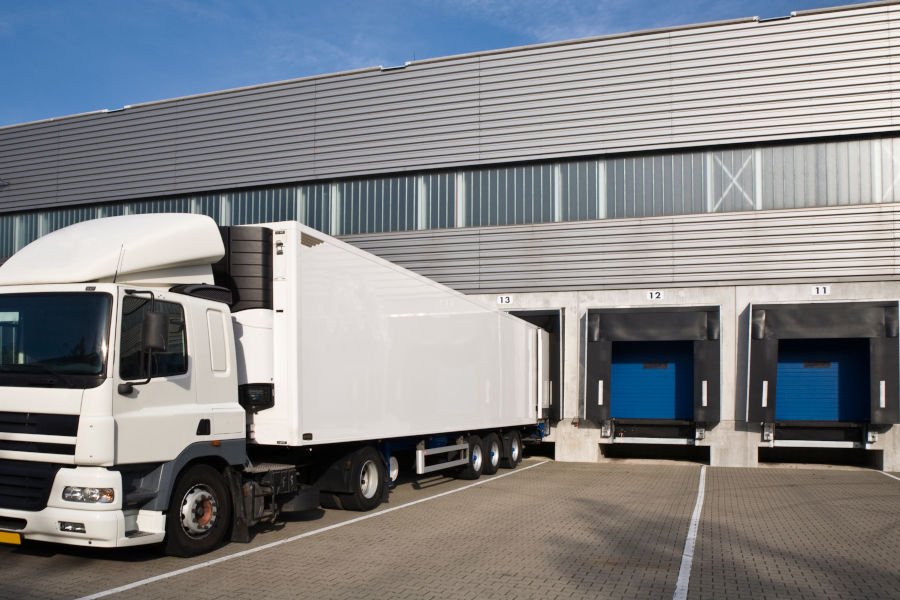
Truck Courts and Dock Aprons in Wyoming
A trailer parked on its landing gear puts a very small foot on a very large load. That single point decides how thick a dock apron has to be, and it explains why ordinary parking lot paving fails at a loading dock within a couple of seasons. We build truck courts, dock aprons, trailer staging areas and approach lanes for warehouses, plants and terminals, with concrete sections sized for the traffic and the winter.
The state runs on trucks. Cheyenne is served by I-25, I-80, US 30, US 85 and US 87, and Union Pacific and BNSF both operate yards there. Rock Springs sits on I-80 with Union Pacific freight rail. Freight arrives from every direction, and in storms I-80 closes while trailers pile up at yards and docks. A truck court that works in a blizzard has room to stack trailers, space for a plow to turn and drainage that does not freeze.
We design the work with the building contractor, not after it. The dock pit, the leveler, the slab edge and the apron have to be built as one system.
Freight corridors and what they do to pavement
The Cheyenne Logistics Hub covers about 2,000 acres southwest of the city with access to both BNSF and Union Pacific, I-80 and I-25, plus transloading and rail car storage. The scale invites heavy truck traffic day and night, and that traffic turns over trailers, not cars. Fully loaded tractor trailers on a thin asphalt section rut and shove within a season, and diesel and hydraulic fluid dissolve asphalt binder over time.
That is why we lean toward concrete for dock aprons and trailer parking at distribution sites. Concrete handles standing loads, resists fuel spills and holds its shape in summer heat. The price is higher up front. The payback is fewer repairs and a longer life, which is why owners with long-term leases on cross-dock and terminal facilities tend to choose it.
Snow, ice and the plow
The plow is the tool that tells you whether the court was laid out well. We ask who clears it, what machine they use and where the snow goes. A court that dumps plowed snow onto a drain inlet will flood the dock in March. A court with no storage space for snow loses parking stalls for months.
Slopes are tricky. A dock apron needs to slope away from the building so water does not run into the dock, but trailers also need to stay level at the doors. We hold the slope to the engineer's tolerance and check it with the survey crew before the pour. Joint layout also matters in freeze-thaw country, since every joint is a path for water. We seal them, and we tell your maintenance staff when to reseal.
Base, thickness and approvals
Concrete thickness comes from the traffic study or the owner's design loads, and the base course under it is as important as the slab. We compact the subgrade, place and test the base and verify drainage before we form. A soft base under a heavy trailer is the usual cause of early failure.
Approvals vary. Local building departments in Wyoming adopt and enforce their own codes, and curb cuts and driveway approaches onto state or county roads need separate permission. Laramie County lists a 36 inch frost line depth and a 32 lb/ft2 ground snow load in its design table, and similar numbers at the building edge affect how footings and aprons tie together. We confirm these early and we do not assume that approvals in one county will match those in the next.
What a full court package includes
Our scope covers grading, subgrade stabilization, aggregate base, formwork, dowels, reinforcement, concrete placement, finishing, curing, joint sawing and sealant. We build drive lanes, apron slabs, trailer pads, dolly pads for landing gear, bollards and wheel stops. Striping, signage and lighting conduit can be included.
The work links to the building. Dock aprons must meet slab edges at the correct elevation, so we coordinate with the commercial concrete floors crew when both are ours. Dirt work comes first through mass grading, which sets the elevations the apron depends on. Owners who need the whole site delivered often ask us to sequence all three as one.
Where the money goes
Thickness is the big number. A court sized for heavy standing trailers can run twice the section of a light-duty drive lane, and it is worth saying clearly which areas get which section. Not every square foot of a yard needs the heaviest slab. Putting concrete where the trailers stand and asphalt where they only drive can save money without losing performance.
Haul distance for aggregate and concrete, winter protection and mobilization round out the price. Casper-Natrona County International Airport has FedEx Express cargo service, a reminder that distribution in Wyoming spans air, rail and road, and that the last leg is nearly always a truck on a county road. We build the final yard for that truck.
When the apron gets poured
Concrete work in the yard competes with the building for the same short season. We aim to finish aprons and courts before the first hard freeze so docks can open on time, and we hold the aggregate base under cover or well-drained through winter if the pour has to wait. Truck traffic from other trades can ruin a finished base, so we protect it or keep heavy deliveries on a haul road.
A distribution center owner usually wants every door working on the opening day, including the ones at the far end of the court. We phase the pours by door group so inspection and cure do not hold up the whole yard. The car lot and employee parking follow the same plan through the parking lot construction trade partner, usually in asphalt.
Send us your trailer count and dock layout
If you know how many doors you have and how many trailers you stage, we can start a section and layout. You can also reach us through our Casper area page, where central Wyoming freight work is planned. For distribution operators, see how we serve logistics and distribution owners.
Questions Owners Ask
Should I use concrete or asphalt for trailer parking?
For standing loaded trailers and regular fuel drips, concrete lasts much longer. Asphalt can work for drive lanes and low-use areas. Many owners combine them, with concrete at the docks and in the staging area and asphalt elsewhere.
How thick should a dock apron be?
The engineer decides from the loads and the subgrade. Heavy-duty sections are common at the docks where landing gear concentrates weight. We follow the design and give you alternatives if conditions change.
How do you handle ice at the docks?
By slope, drainage and layout. Water has to leave the apron before it freezes, and plowed snow needs somewhere else to go. We also recommend heated trench drains or sloped aprons away from doors in the coldest sites.
Can you pour a truck court in cold weather?
Yes with protection, though a hard freeze can stop us. We use blankets, heaters, cold-weather mixes and set conditions on temperature. A spring pour may suit your schedule better.
When should the apron be built relative to the building?
Often after the shell is closed and before the building is occupied, so heavy equipment does not damage the apron. Sometimes it goes in earlier to serve as a laydown yard. We decide with the owner.