
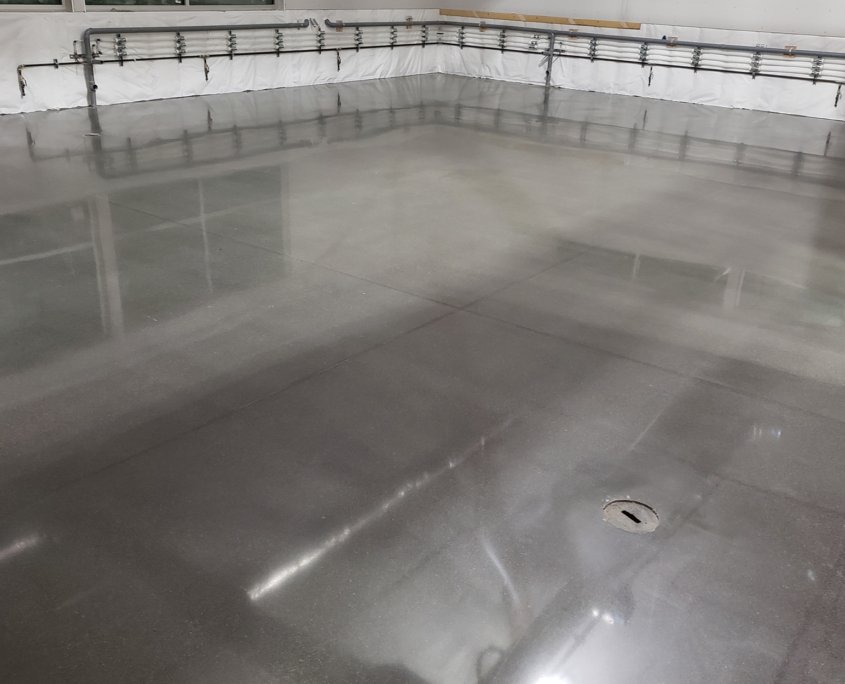
Commercial and Industrial Concrete Floors in Wyoming
A forklift finds every flaw in a floor. Slab flatness, joint condition and surface hardness decide whether a distribution aisle runs smoothly for years or chews up wheels and loads in months. We manage slabs on grade for warehouses, plants, shops, cold rooms and light industrial buildings, and we treat the floor as a product with specifications, not as a leftover pour at the end of the shell.
Wyoming adds a few conditions. Cheyenne Business Parkway alone covers 900 acres east of the city, and North Range Business Park lists tenants that include a Walmart distribution center and Microsoft. Big boxes, big floors and long delivery chains are normal there. Wind dries a fresh slab faster than the finishers can work, nights can fall below freezing in shoulder seasons, and the nearest ready-mix plant may be an hour from a remote site.
We plan the floor around those facts before we schedule the pour. The decisions made in preconstruction on mix, joint spacing, subgrade and enclosure protect the slab more than any finishing skill on the day.
Crews that place and finish
Finishing is a trade. We keep placement, screeding, floating and troweling in the hands of crews that do it every week, and we bring in laser screeds and power trowels sized for the floor area. A large slab goes in as a series of planned strips, with the finishers, the pump and the trucks timed to each other. If one piece slips, the whole pour is at risk of setting before it is finished.
We also manage the prep. That means subgrade proofing, vapor barrier or capillary break where required, forms, dowels and reinforcement. The best finishing in the world cannot fix a base that was never proof-rolled. We keep a short list of items we check before any truck is ordered, and none of them is optional.
Wind, cold and the first 72 hours
Rapid surface drying is the enemy of a good slab. On the plains, dry air and steady wind can pull moisture out of the surface faster than bleed water rises, leading to plastic shrinkage cracks and a weak top layer. We use windbreaks, evaporation retarders, fogging and early curing, and sometimes shift the pour to cooler hours.
Cold has the opposite effect. Rawlins has recorded temperatures from 98 F down to minus 36 F, a range that shows what concrete can face over a year. A slab placed in a heated, enclosed building cures predictably. A slab placed in an open shell in November does not. We recommend closing in and heating the building before the interior floor goes in whenever the schedule allows, and we price temporary heat so that you can weigh it against delay.
From base course to cured slab
A typical commercial floor package covers compacted base, vapor retarder, reinforcement or fibers, joint layout, placement, finishing, curing, saw cutting and joint filling. Many projects add hardeners, sealers or polished finishes. Dock areas get thicker sections and heavy dowels at the leveler pits, since that is where the loads concentrate.
We integrate the floor with the rest of the building. Slabs for a cold storage facility need under-slab heating or insulation so that the soil does not freeze and lift the floor, which is a systems decision, not a concrete decision. Floors in a distribution center need tight flatness numbers for high-bay racking and narrow aisle equipment. We build to those tolerances and measure them.
Fitting the pour into the shell
The floor sits at an awkward point in the schedule. It is needed early, to be a work surface, and late, to avoid damage from other trades. We usually place the slab after the building is closed in, but some projects, especially tilt-up buildings, use the slab as the casting bed and need it first. We decide the sequence with the owner and the structural team in preconstruction.
Curing adds days to the calendar before racking or equipment arrives. We tell you the minimum cure and the safe load date, and we hold to them. Where the supply chain is long, we confirm mix design, aggregate source and truck count several days before the pour. For large logistics buildings, see how this fits with our fulfillment and logistics center construction.
What the floor costs and why
Thickness, reinforcement, flatness class and finish drive price. A floor for pallet racking with narrow aisles costs more than a floor for open storage. Joint design matters too. Fewer joints mean a better floor and a higher up-front cost, with systems such as shrinkage-compensating concrete or post-tensioned slabs. We lay out the choices and the long-term maintenance implications.
Remote delivery and winter protection are the Wyoming add-ons. Truck time, standby charges and temporary heat can be real money, so we price them separately. Related surfaces such as dock aprons and truck courts are often better treated as a single concrete package, which saves mobilization.
Owners who care about floors
The people who feel a bad floor first are the ones running forklifts. Operators in logistics and distribution measure floors in lost time and damaged product. Retail chains, and in particular large-format stores that run pallet jacks and floor scrubbers all day, care about flatness and joint edges. Our retail chain clients usually ask for a seamless, easy-clean finish.
Manufacturers need a floor that can take point loads, chemicals and vibration. We ask what the equipment weighs, how it is moved and what spills on it, then specify the slab to suit. Getting that conversation done early is worth more than any admixture.
Tell us the loads and the aisle width
If you have a racking plan or an equipment list, send it along. We can tell you what flatness, thickness and joint layout fit your operation. Many floor inquiries start in Cheyenne, where the big boxes are going up.
Questions Owners Ask
How flat can a warehouse floor be?
Flatness is specified with industry measures, and the owner chooses the class. Standard warehouse floors are fine for pallet jacks, while very narrow aisle racking needs a much tighter spec. The floor is placed to the specified class and tested after the pour to confirm it.
Can you pour a slab in winter?
Yes, if the building is enclosed and heated, or if we protect the slab with blankets and heaters. An open shell in a hard freeze is the risk. We can price a heated enclosure and a spring pour side by side.
Why do slabs crack and what do you do about it?
Concrete shrinks as it dries, so some cracking is normal. Joints control where it happens. We cut joints at the right time, keep the slab moist, and avoid fast surface drying. In Wyoming wind, we treat curing as part of the pour.
How long before I can load racking?
That depends on mix, temperature and design, and it is typically several days to a couple of weeks. We give you a date based on cylinder breaks, not a guess. Lightly loaded work can start earlier.