
Mass Grading for Commercial and Industrial Sites in Wyoming
Dirt moves cheapest when it moves once. On a Wyoming site that means cut and fill balanced on paper before the first scraper turns, because the next borrow source or disposal site can be a long haul down a county road and trucking is paid by the hour. We grade pads, yards, access roads and detention areas for commercial and industrial owners, and we start from the geotechnical report, not from a rule of thumb.
Scale runs from a three-acre building pad to a business park. Cheyenne LEADS delivered infrastructure to the 1,100-acre High Plains Business Park between April 2024 and December 2025: two sanitary sewer mains, a water main, a new 4.5-mile road and a traffic signal on US 85, split across seven bid packages. That is how large ground gets opened here, in pieces, with the earthwork sequenced ahead of each utility and each road. A small pad follows the same logic at smaller size.
The season sets the pace. Frozen ground cannot be compacted, and wet ground in April cannot carry a loaded scraper. We plan grading around those limits and we price the idle days honestly.
What the ground tells us before we bid
We want the boring logs and the lab results before we commit to a number. Clay that holds water, cobbles that wreck a blade and shallow bedrock each change the haul plan and the equipment list. On the plains east of the mountains the topsoil is thin and the subgrade under it may be expansive, so we strip, stockpile and respread with the finished slopes in mind instead of treating topsoil as waste.
Moisture is scarce in most of the state, which helps in summer and hurts in a different way. Dry material will not compact without water, and the water truck may have a long cycle from the nearest hydrant or tank. We add that cycle time to the schedule. Where a site drains toward a neighbor, a road or a creek, we settle the grading plan with the engineer and the reviewing agency early, because a late change to a pond or a swale ripples through every pad elevation downstream. Pad drainage connects directly to our stormwater and drainage work.
Cuts, fills and everything between
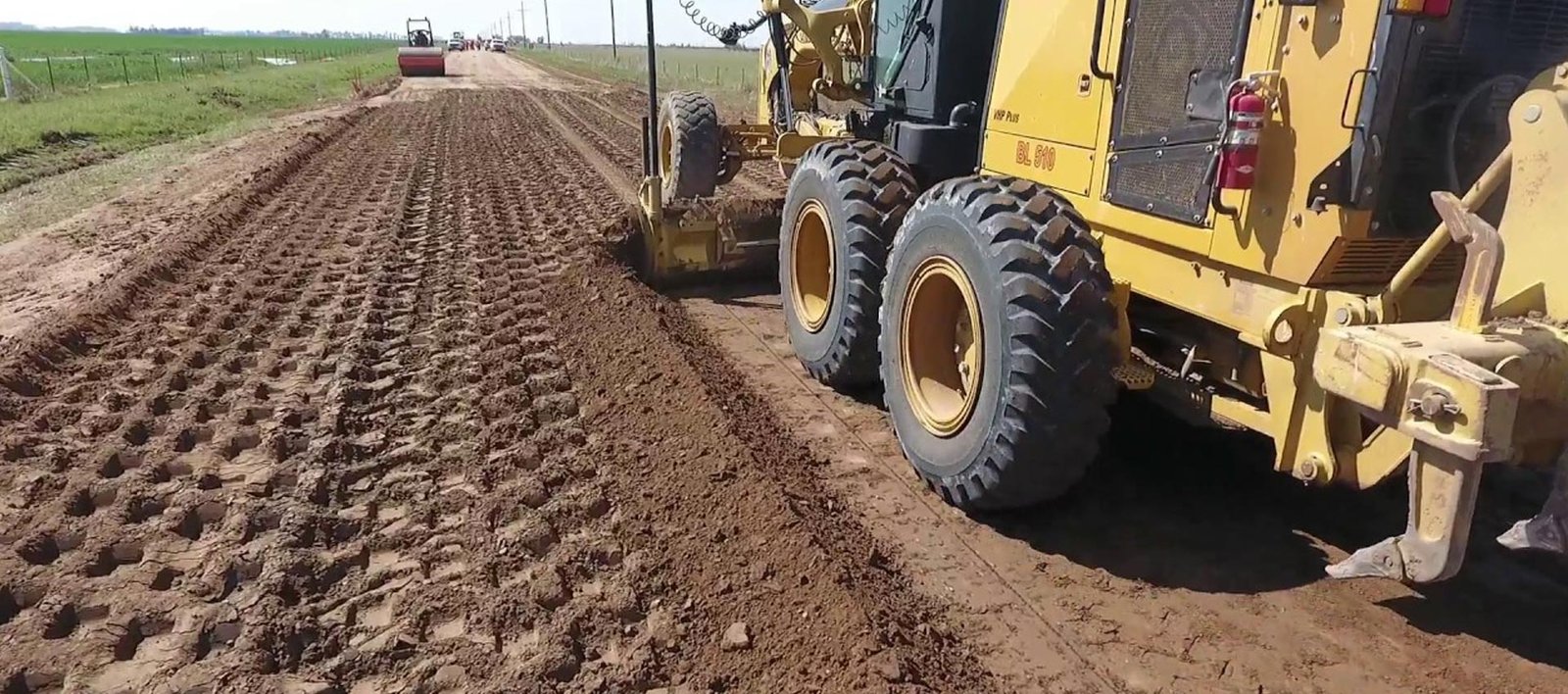
A typical mass grading package covers clearing, topsoil stripping, bulk cut and fill, subgrade preparation, benching of slopes, haul roads and temporary erosion control. We keep survey on the machines through GPS grade control, with a survey crew checking behind them. Building pads are overbuilt and trimmed to final elevation so the footing and slab crews inherit a clean, tested surface.
Large yards for trailers, laydown and docks need their own subgrade design, since a trailer corner loads the ground far harder than a car does. We coordinate pad work with the paving and concrete scope of truck courts and dock aprons so base thickness, slopes to drain and joint layout agree with the dirt. On logistics campuses and similar projects, the same earthwork contractor should leave behind a pad that the fulfillment center builder can start on the next morning.
Permits, frost depth and local rules
Wyoming has no single statewide building code. Adoption and enforcement happen at the city and county level, and design values are set locally. Laramie County lists a 32 lb/ft2 ground snow load, 105 mph wind speed and 36 inch frost line depth, while the Town of Wright publishes 30 psf ground snow, 90 mph wind and a 42 inch frost line. Grading touches those numbers because fill placed under a footing has to be built to the same frost and bearing assumptions the designer used.
Earthwork permits, stormwater plans and any floodplain or road-approach approvals depend on the jurisdiction, and some sit at the county, some at the state. We confirm which office reviews what before we promise a start date, and we keep the permit set on site. A reviewer a few hours away does not forgive a missing page.
Working the weather window
Most open ground in the state gives a real earthwork window from late spring through fall, with shoulder season on each end. We plan to finish the bulk cut and fill, and the compaction testing, before hard freeze. Winter grading is possible on thawed or well-insulated areas, but it costs more and the testing has to be honest. Frozen lumps buried in a fill become settlement later.
Wind is a schedule input too. Dust control is a permit item on many sites, and a gusty week can stop a water-dependent operation entirely. When mobilization means a crew traveling to the site, we hold the equipment there through the job instead of bouncing it back and forth. Getting that haul right is a big part of why we scope commercial construction as one continuous plan and not as disconnected trades.
Where the earthwork number moves
Haul distance, import or export volume, rock, groundwater and moisture conditioning drive the price more than the acreage does. A balanced site is cheap. A site that needs ten thousand yards imported from a pit an hour away is not. We show the quantities and the assumptions so you can see which line moves if the soil report changes.
We also price the pad for the next trade, not only the grade. A pad that is a few tenths out of tolerance costs the slab crew time, and a pad left wet costs the whole schedule. Owners developing an industrial or data campus in stages often benefit from rough-grading the whole site once and finishing pad by pad, and we run that numbers comparison in preconstruction. Industrial owners, in particular those in manufacturing, tend to value that early certainty.
Send us the site and the soil report
If you have a survey and a geotechnical report, we can give you a cut and fill read quickly. If you have only a parcel and a plan, we will walk it with you. Call us and talk to the person who will price the dirt. See also our work on drainage systems and our work near Wright.
Questions Owners Ask
How much does frost depth change a grading plan?
Quite a bit. Fill placed under future footings has to be compacted to the same standard as the foundation design, and the local frost line sets how deep the footing goes. Wright lists 42 inches and Laramie County lists 36 inches, for example. We stage grading so footing excavation does not cut into fill that was placed too late in the season.
Can you grade in winter?
On some sites, yes. Ground that stays thawed under insulation, or small areas that can be thawed and backfilled the same day, can be worked. Large fills in a hard freeze are a bad bet. We tell you which category your site falls in and what it adds to cost.
Do I need to buy dirt or can the site balance?
We balance cut and fill on paper first. If the site is short or long, we price import or export with the actual haul distance, not an average. Topsoil, rock and unsuitable material get their own line.
Who tests the compaction?
An independent testing lab, scheduled with the earthwork trade partner so results come back while the equipment is still on site. If a lift fails, we recompact the same day instead of waiting for a report. Remote sites sometimes mean a technician has a long drive, so we book that early.
How early should grading start relative to the building contract?
As soon as permits allow, since dirt work is the one scope that benefits from settling time and an early start. Many owners release site work ahead of vertical construction so the pad is ready when steel or panels arrive.