
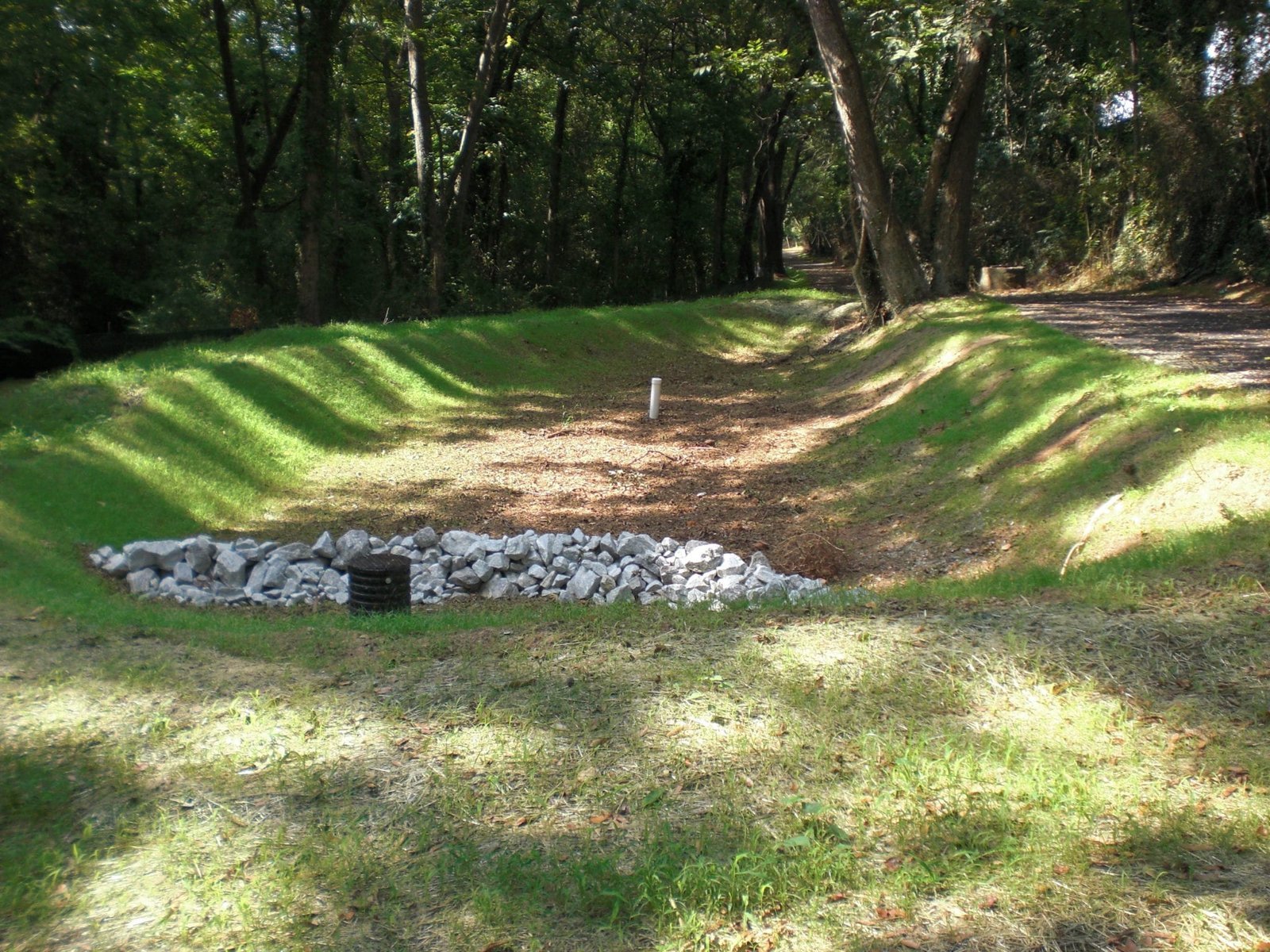
Stormwater and Drainage Systems for Wyoming Commercial Sites
It almost never rains in most of this state, and then it rains hard on frozen ground. That is the design problem. Laramie sees about 11 inches of precipitation a year, but it also gets about 48 inches of snowfall at roughly 7,165 feet, and the melt in March and April has to go somewhere that is not your loading dock or your neighbor. We build the pipes, inlets, swales, ponds and outfalls that carry it away from commercial and industrial sites.
Drainage here is a winter and spring problem more than a summer one. Ice forms in outfalls, culverts freeze solid, and snow piled by the plow can bury an inlet until the first warm day. A system that looks perfect on a July survey can fail in the first thaw if nobody asked where the plowed snow goes. We ask that question during layout and we put the answer on the plan.
We also coordinate this work next to mass grading, since the pad elevations and the drainage routes are the same decision made two ways.
Thin rain, hard snow, long melts
Sundance sits in the Black Hills at about 20.4 inches of annual precipitation and about 81 inches of snowfall. Lovell, on the dry side of the Bighorn Basin, gets about 6.45 inches of precipitation and about 13.3 inches of snow. Those two towns are a few hours apart and need very different drainage. The Black Hills site manages volume and slush. The basin site manages a rare thunderstorm that arrives all at once on hard, crusted soil.
We look at the specific watershed, not the regional average. Culverts sized for a 25-year storm in one county may be oversized in the next, and the reviewing agency decides what storm the site has to handle. We read the local drainage criteria, size to the stated storm and then check the design against a thaw, since a thaw with frozen pipes and a full pond is where owners get surprised.
Pipes, ponds, swales and outfalls
Our drainage scope includes storm sewer, inlets and manholes, culverts, trench drains at docks, detention and retention basins, rock-lined channels, outlet structures and erosion control. Pipe is installed to the engineer's grades with laser or GPS control and we test it where the specifications call for testing. Backfill gets compacted in lifts, because a pipe trench that settles under a parking lot shows up as a bird bath within a year.
Detention is the big cost on larger sites. Ponds take land, so we coordinate their location early with the owner, the engineer and the planner. A pond that eats the space meant for a future building is an expensive surprise. On sites with a self-storage or parking use, a flat roof area adds runoff while paved lots add speed, and we review both when we look at a self-storage layout or a parking lot.
How we plan a drainage job
We walk the site in the wet season when we can, because the ground shows where water actually goes. Then we compare that to the plan. Where the plan and the land disagree, we raise it before a headwall is poured. The owner decides, and we price the change in plain numbers.
Sequence matters. Storm sewer goes in before the base course, and the base course goes in before the asphalt, so we hold the crew until the lines are inspected and the trench is closed. If a freeze is forecast, we cover open pipe ends and keep the backfill dry. Our property clients, and especially those that run property management firms, tell us that the first maintenance call after a thaw is nearly always a drainage call. We build to avoid it.
Contamination, floodplain and review
Drainage permits usually run through the city or county, sometimes with a state stormwater requirement for larger disturbed areas. Some sites sit in a mapped floodplain or next to a river such as the North Platte, and that adds review. We check the maps first and we ask the reviewer what they want to see before we submit.
Some Wyoming ground carries a history. The Mystery Bridge and U.S. Highway 20 Superfund site in Evansville involves groundwater contamination believed to come from former industrial operations. On any site with industrial history, we want the environmental reports before we dig or discharge, because a trench can intercept groundwater and move it somewhere it should not go. That is a conversation for the owner, the engineer and the regulator, and we make sure it happens early.
Trenches and cold-weather work
Trenches over five feet need protection, and in cold weather the walls behave differently. Frost lets a wall stand until a thaw and then lets it go. We shore, slope or box every trench to the standard, we check it every morning and after every weather change, and we keep spoil back from the edge.
Winter pipe work needs careful handling. Plastic pipe gets brittle, gaskets stiffen and wet backfill freezes into chunks. We warm material when needed, bed in clean thawed fill and do not place frozen lumps against pipe. Crews travelling long distances to a site also need a plan for fuel, water and warm-up time, and we build it into the day.
Drainage as part of the whole site
Few owners buy drainage alone. It sits inside a larger site package that includes utilities, paving and building pads, so we coordinate with our site development and utilities work to avoid conflicts between storm, sewer and water lines. Crossings are where mistakes hide.
When the building or lot is done, we walk the first big melt with you and check every inlet and outfall. If something runs where it should not, we fix it while the crew and equipment are still in the region.
Tell us where the water goes
Send us the grading plan and the drainage report, or tell us you do not have one yet. We will walk the site, compare plan to land and price the pipes and ponds. We also work through Laramie and the Snowy Range country, where thaw season is the real test.
Questions Owners Ask
How do you size detention for a snow-heavy site?
The reviewing agency sets the design storm, and we size to that. We then check snowmelt on frozen ground as a separate case, since melt over several days can fill a pond that was designed for a short summer storm. Where the engineer allows, we add freeboard and a controlled outlet that will not freeze shut.
Will my outfall freeze?
It can. Small pipes and shallow culverts freeze first. We set invert depths with frost in mind, use larger pipe where it matters and specify outlet protection that can take ice. We also tell your maintenance staff where to clear snow in winter.
What if the site has old industrial contamination?
Stop and get the environmental reports before any excavation. Dewatering and discharge rules can change if the groundwater is impaired. We work with your environmental consultant and the regulator, and we price the extra handling separately.
Does drainage have to be done before paving?
Yes. Storm lines, inlets and pond grading go in first so the base and asphalt are not cut up afterward. Tearing out new pavement for a missed pipe is the most expensive way to learn that lesson.