
Site Development and Utilities in Wyoming
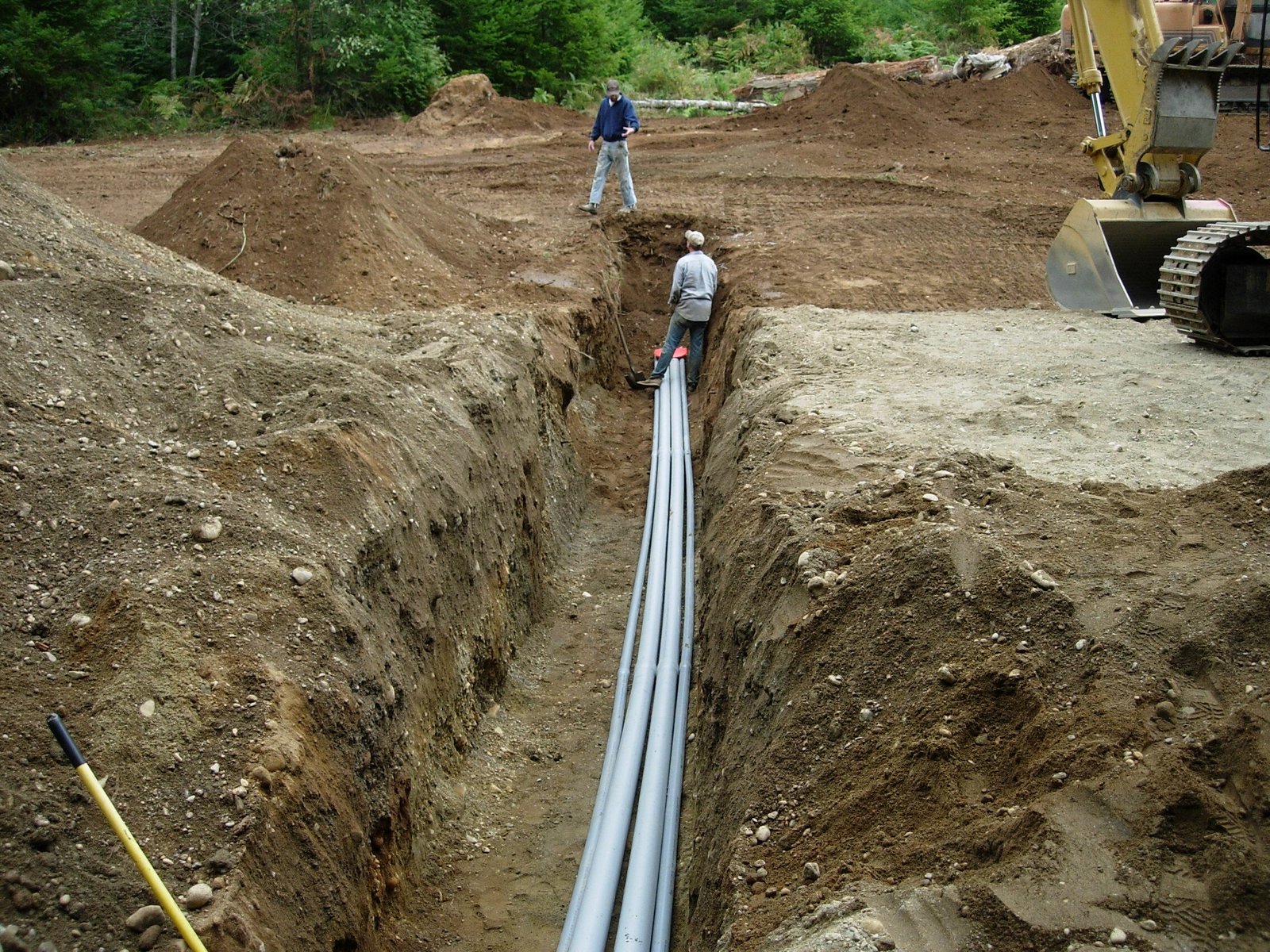
Before there is a building there is a trench. In Wyoming, that trench may be forty miles from the nearest supply yard and cut through ground that freezes to the depth of a man. We build the underground and the grade that every building depends on: roads, sewer, water, storm drainage, power and fiber. When it is done right nobody notices. When it is done wrong, everything above it moves.
The scale of utility work can rival the building. Cheyenne LEADS delivered two sanitary sewer mains, a water main, a new 4.5-mile road and a US Highway 85 traffic signal to the High Plains Business Park between April 2024 and December 2025. The Wyoming Business Council approved $617,483 for roughly 30,000 linear feet of fiber optic cable near the Casper airport business park. Those are site development projects.
We handle the same kinds of work at a smaller scale for owners building a shop, a plant or a warehouse: clearing, grading, utilities, paving and drainage, delivered ahead of the building so the foundation can start on time. We also prepare pad-ready lots for commercial real estate developers who sell or lease parcels.
Equipment, crews and one schedule
Site work is equipment-heavy, and we manage a large share of it directly. We schedule the excavators, dozers, graders and compactors, and the underground pipe, structures and base course. Managing it closely means we control the pace and the quality, and we are not waiting on a sub who is booked elsewhere.
On remote sites, that control matters more. Equipment mobilization is a major cost, and a crew that can do grading, utilities and paving in one visit saves a second trip. We plan mobilization to keep machines working and moving.
Grade, pipe, pavement
The scope starts with clearing, stripping and mass grading, followed by the building pad, with compaction tested. Then comes underground work: sanitary sewer, water service, stormwater drainage, culverts, detention and conduit for power and communications. Last are the base, curbs, paving, striping and finish grading.
We coordinate with utility providers early. The utility owns the connection, and its schedule drives ours. The concrete foundations and warehouse construction trade partners rely on the pad being ready on the date we promised.
Frost depth and local requirements
Burial depth, trench backfill and pavement design all respond to frost. The Town of Wright publishes a 42 inch frost line and a 1900 air freezing index, along with a 30 psf ground snow load and a 90 mph design wind speed. Other jurisdictions publish other numbers, and they range from 34 to 54 inches across the examples in the state. Water lines go below frost; shallow lines need insulation.
Permits come from the city, county, utility and sometimes state agencies. Stormwater, floodplain, road access and utility extensions each have their own review. We prepare submittals and track each approval so the schedule is not a surprise.
Soils, drainage and wind
Soils decide a lot. Clays swell and shrink, sands drain but erode, and shallow rock slows trenching. We recommend a geotechnical investigation before pricing, because a surprise below the topsoil can cost more than the building pad. Drainage on the high plains is dominated by snowmelt and short, hard storms, and culverts and detention are sized accordingly.
Wind dries grading work and blows dust and snow across open sites. We plan dust control and snow storage, and we orient truck courts and entrances so drifts do not close the access. These choices are cheap during design and expensive to fix later. Existing utilities are the other unknown. Old lines, abandoned pipe and unmarked services turn up on parcels that have been used before. We call for locates, pothole the critical crossings and keep a record of what we find so it does not hurt the next owner.
Moving dirt before the freeze
Earthwork wants dry, unfrozen ground. The window runs from spring thaw to the first hard freeze, and every week inside it is valuable. We aim to finish grading, underground and pad work before freeze-up so foundations can proceed. Frozen subgrade and wet clays are the two things that stop a job.
Utility lead times for transformers, switchgear and pipe can run for months. We order early and track each item. If a utility extension is out of our control, we tell the owner immediately and adjust the plan. Before winter shutdown we protect open trenches, cap lines and flag excavations so spring starts where fall left off. Compaction tests, pipe pressure tests and as-built records are part of closeout, and we deliver them before we leave the site.
Across the state, from corridor to county road
We build site work along the I-25 and I-80 corridors and run travel crews to counties off the interstates. Industrial parks in Cheyenne and Casper have utilities at the edge, while rural parcels may need a long extension.
County roads are part of the job too. Haul routes, load limits and seasonal closures affect materials delivery. We plan routes and talk to the county road department when needed.
What drives site and utility cost
Quantities drive cost: cubic yards, linear feet of pipe, tons of base and asphalt. Distance drives it too, since aggregate, pipe and concrete have to travel. Unsuitable soils, rock and groundwater can turn a simple extension into a major cost. Offsite requirements, such as turn lanes or a signal, can be large.
We break the site budget into clear pieces and show the unit costs, so owners can see where choices matter. Our preconstruction estimating work includes a site walk and a review of utilities at the property line.
Get your site ready
Send us the parcel, the building footprint and the utilities nearby. We will price the grading, the underground and the paving together.
Questions Owners Ask
Who pays for utility extensions to a rural parcel?
Usually the owner, though some utilities share costs or recover them through connection fees. We find out what the utility requires early and include it in the budget.
How deep do water lines need to be buried?
Below the frost depth set by the local jurisdiction. Published values range from 34 inches to 54 inches in the examples across the state, and shallow lines need insulation or heat. We confirm the depth with the building department and the water provider.
Can you do site work in winter?
Limited work, yes. Frozen ground slows excavation and compaction, and snow complicates everything. Utilities in trenches can be installed with care. Most grading and paving is best done in the warm months.
Do I need a geotechnical report?
For nearly any building larger than a shed, yes. The report tells us the bearing capacity, frost susceptibility and groundwater, and it prevents expensive surprises.
How do you handle stormwater?
By grading to move water away from buildings and into detention or a drainage way sized for local storms. Permits may be required. We design for snowmelt and heavy summer storms.