
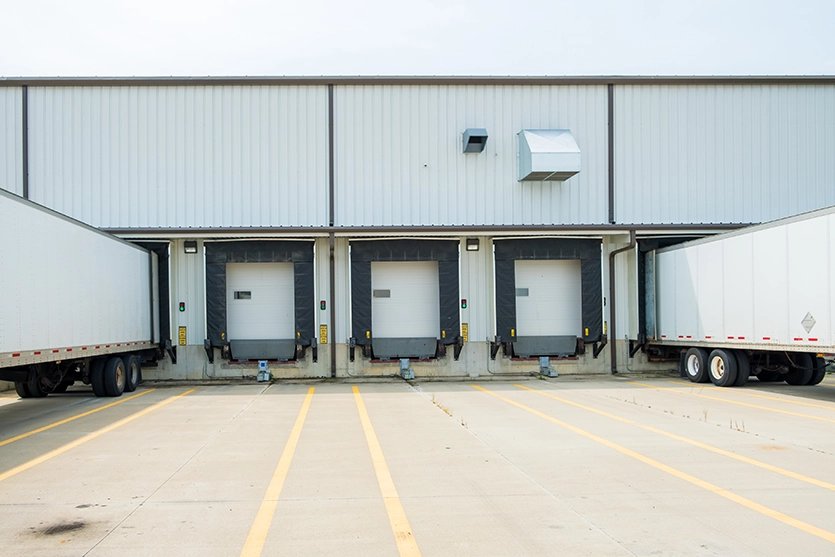
Truck Terminal and Cross-Dock Construction in Wyoming
How many minutes does a trailer sit at the door? That one question decides whether a cross-dock makes money. Freight comes in on one side, gets sorted and goes out on the other, and every minute of delay multiplies across dozens of doors. The building is thin and long, the yard around it is large, and the pavement takes more punishment than any slab in a conventional warehouse.
In Wyoming, terminals sit along the highways that carry freight across the state. Rock Springs, Rawlins and Evanston are on I-80, Douglas is on I-25, and Buffalo sits where I-25 meets I-90. Those towns are hours apart, so a terminal here often has to serve a huge territory and survive a winter day when the next truck is slow to arrive. We design for that rhythm.
Our work on distribution centers and truck terminals shares a lot, but a cross-dock puts even more weight on the dock wall, the apron and the drainage. We build the building and the paving as a single system.
A long, narrow building and a heavy yard
A cross-dock is usually a rectangle with doors on both long sides, often with a width of 100 to 200 feet so freight can cross without long forklift runs. We frame it with a clear span or a few rows of columns, set dock doors at the spacing your carriers need and place levelers and seals at each. Interior floors take constant forklift traffic, so the slab is thick, reinforced and carefully jointed. Our commercial concrete floors work handles those specifications.
The yard is as important as the building. Tractors turn, trailers back and landing gear loads concentrate at the dock. We use thick concrete aprons at the doors and heavy-duty paving through the drive lanes. Where diesel and fuel drips are likely, concrete outlasts asphalt. The balance between concrete and asphalt is a decision about money and maintenance, and we price both paths so you can see the long-term cost.
Reading the highway map
The towns along the interstates are the logical places for terminals. Rock Springs, at 6,388 feet, sits on I-80 with US 191 and WYO 370 and has Union Pacific freight rail service. Rawlins has I-80 on its south side with a business loop through the center, US 287 and Wyoming 789, along with Union Pacific rail. Evanston is bisected by I-80, with US 189 and Wyoming 89 and 150 in the area.
Douglas has I-25 running concurrent with US 87, plus Wyoming Highways 59, 91, 93, 94 and 96. Buffalo sits on I-25 near its northern end where it joins I-90. Each of these is a natural stopping and sorting point for carriers on long routes. Truck volumes and carrier plans vary, so we ask about your lanes, your expected trailer count and your growth plan before we lay out the yard.
Why the pavement costs more than people expect
On a terminal, paving can account for as much of the budget as the building. Heavy axle loads, repeated turning and standing water all shorten pavement life. Subgrade work, base thickness, drainage and joint design determine whether the yard lasts or ruts out in three winters. In Wyoming, freeze-thaw cycles open any weakness, so we put the money into subgrade and drainage. The stormwater drainage trade partners build the inlets, swales and detention that keep water off the apron.
Travel adds cost too. Concrete and base material come from far away on remote sites, so we test local sources and haul distances early. We also consider phasing. A terminal can start with a smaller building and a partial yard, then add doors and pavement as volume grows. Planning the first phase to accept the second keeps the extension cheap.
Keeping drivers and workers apart
A terminal mixes tractors, trailers, forklifts and people on foot. Good layout separates them: separate gates for cars and trucks, marked walkways, clear sight lines and enough lighting for winter afternoons that end at dusk. We design the yard so drivers are not backing across foot traffic, and we place yard lighting to cover every door and corner.
Fire protection and fuel storage get early attention. Some terminals hold fuel tanks, wash bays or maintenance shops, each with its own code requirements. Wyoming has no single statewide code, so the local building and fire officials decide which edition governs. The state adopted the 2024 International Codes on June 28, 2024, and cities and counties with delegated authority adopt on their own schedules. We confirm early and design to what will be in force at permit.
From the Wyoming line to the northern plains
We build along the freight routes, from Rawlins and Douglas to Buffalo and the I-80 corridor in the south. Travel crews handle the long hauls, and local suppliers are used wherever they have the capacity. Because distances are large, we can build the same terminal design in more than one town and share the engineering. Our programmatic multi-site rollouts team handles that work.
Owners who run a regional network may also want to look at the logistics and distribution industry page and our flex and light industrial building page, since a small satellite depot sometimes fits better than a full terminal. We help you choose the right scale for each stop.
Plan a terminal on your lane
Share your lanes, door count and parcel. We will explain what the winter, the paving and the haul do to the budget and give you a clear schedule. One phone call starts it.
Questions Owners Ask
How wide should a cross-dock be?
It depends on your freight, but many fall between 100 and 200 feet wide. Narrow buildings shorten forklift runs. Wider buildings give more staging room. We work from your volume and sort method before we pick the width.
Should the apron be concrete or asphalt?
Concrete lasts longer under heavy axle loads and spilled fuel, and it costs more up front. Asphalt costs less but needs more maintenance. Many owners use concrete at the dock and asphalt in the outer drive lanes. We price both so you can see the lifetime cost.
Which Wyoming towns make sense for a terminal?
Towns on the interstate corridors, such as Rock Springs, Rawlins and Evanston on I-80, Douglas on I-25 and Buffalo on I-25 and I-90, are the natural candidates. The best choice depends on your lanes and your drivers' hours. We help you compare sites using the real road and rail map.
What does snow do to terminal design?
It affects drainage, lighting, door location and storage. We provide snow storage on the site plan, slope the yard so meltwater leaves the apron, and place doors out of the prevailing drifts. A terminal that cannot clear snow quickly loses money.
Can we phase the building?
Yes. A first phase can include a portion of the dock wall and the yard, with the remaining doors added later. We stub utilities and set the slab edge to take the extension. Phasing lowers the first cost and keeps growth open.