Deep Drilled Pier Foundations in Wyoming
When the soil near the surface cannot carry the building, the load has to go deeper. A drilled pier is a concrete column cast in a hole, usually 18 inches to several feet across, reaching down to rock or to a stiff layer that can take the weight. The need shows up in Wyoming more than owners expect. Expansive clays, loose alluvium along river corridors and weak shallow layers all push engineers toward piers.
Scale is a good reference. The Chokecherry and Sierra Madre wind project south of Rawlins describes about 600 turbines up to 390 feet tall, and every one of those towers needs a foundation that resists overturning in a country with serious wind. We do not build turbines, but the same physics applies to a crane building, a tall silo, a bridge crane runway or an equipment skid that sees repeated loading. Deep foundations are how you answer lateral load and uplift on the plains.
We drill, place steel and pour concrete as one crew, with an engineer and a testing agency checking what we find.
Drill, clean, cage, pour
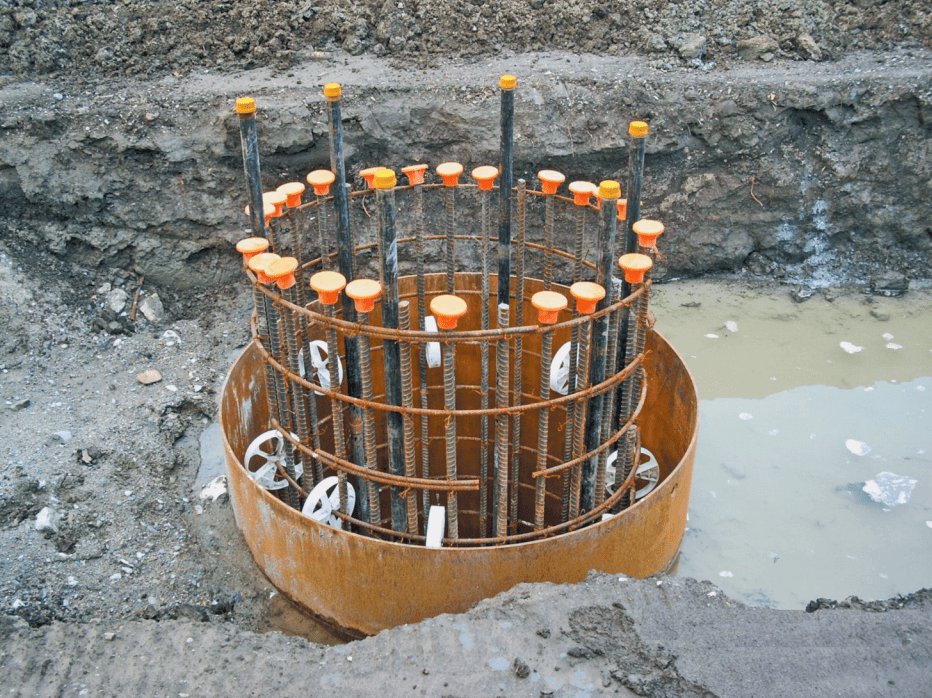
The sequence is simple. We survey the pier locations and set the rig. We drill to the design depth, using casing or drilling slurry if the hole will not stand open. A pier hole has to be clean at the bottom, because loose cuttings under a pier act like a soft spot under a footing. We inspect the hole, lower a reinforcing cage with spacers so the steel stays centered, and place concrete from the bottom up with a tremie when water is present.
Caps and grade beams tie the piers together afterward. We coordinate that work with the concrete foundation scope so the pier tops, anchor bolt layouts and grade beam steel come together without field changes. Piers for heavy equipment or a bridge crane runway also need tight tolerance on top elevation, which we survey before the next trade arrives.
Why Wyoming ground calls for piers
The state is large and the ground is not uniform. Seismic and wind criteria vary by place: Evanston's load sheet lists seismic zone D1 for residential, and Teton County lists a minimum seismic design category D, while the Town of Wright lists category C. Those values change how much lateral force a foundation must resist, and drilled piers are one of the tools engineers use for it.
New industrial work raises the stakes. TerraPower's Natrium plant at Kemmerer, a 345 MW sodium-cooled reactor, is a reminder that large heavy structures, like a data center hall, are being built in small western towns, far from big equipment yards. Rigs, casing and concrete have to travel there. We plan for that haul, and we do not assume that a rig can be on site on a day's notice. For cold storage buildings and other heavy structures with frozen-floor concerns, piers also keep loads away from soil that may heave.
What we supervise directly
We keep the work that decides quality under close supervision: layout, hole inspection, cage placement and the pour. Drilling rigs can be ours or a specialty subcontractor's depending on diameter and depth, and we tell you which at bid time so you know who is accountable. A project of any real depth benefits from a rig that has already worked rock and cobbles in the region.
We also manage the paperwork that goes with piers. Logs of each hole, concrete volumes poured against theoretical volume, and any deviation from design go to the engineer the same day. If a hole hits something the report did not predict, we stop and call before the concrete arrives, not after.
Open holes and heavy iron
An open pier hole is a hazard. We cover or barricade every hole at the end of each shift, keep workers out of unshored shafts and follow the regulations for any entry. Rigs are heavy, and they sit on pads that have to be built and checked for soft ground. After rain or thaw, we recheck before the rig moves.
Wind adds another layer. Reinforcing cages are tall and light, and a gust can swing one into a crew. We set lift limits with the crane operator and shut down when the wind says so. Crews travel and often live near the work, so we also plan for fatigue on long drilling days.
Rigs, concrete and the freeze
Pier work is faster than people expect once the rig is on site. A good crew can complete several holes in a day under the right conditions, but mobilizing the rig is the part that eats time. Scheduling starts with finding the rig, then the concrete supplier and the testing agency, then the weather. We try to bundle the drilling into a single mobilization wherever possible.
Cold slows everything. Concrete in a pier hole is insulated by the ground, which helps, but the top few feet and the cap are exposed. We protect those and keep the mix warm. If an owner needs the foundation done before hard freeze, we tell them early enough to hold the rig. Owners who value that approach often come to us through cold storage construction, where a frozen floor makes the foundation decision critical.
Design, testing and local review
A drilled pier is engineered, so the design starts with a geotechnical report and a structural drawing, not with us. Your local building department reviews it under whatever code edition it has adopted. Wyoming does not have one statewide building code, and the state adopted the 2024 International Codes on June 28, 2024, with local governments adopting and amending on their own timelines.
Special inspection is normal for piers. An inspector watches the drilling, confirms depth and bearing, and checks the cage. Concrete is sampled and broken at set ages. We coordinate all of it and keep the records for the owner. For government and public clients, who buy under strict documentation rules, see our work in the public sector.
Ask us about your boring log
Send the geotechnical report and structural plans and we will tell you what the piers look like in time and money. If your project is in the south-central part of the state, our Rawlins area work shows how wind and distance shape deep foundations.
Questions Owners Ask
When do I need drilled piers instead of footings?
When the shallow soil cannot carry the load, or when the building produces large uplift or lateral loads. The geotechnical engineer makes that call from boring data. If your report shows weak or expansive layers, ask them to compare piers against over-excavation.
How long does the rig need to be on site?
For a typical commercial building, a few days to a couple of weeks, depending on the number and depth of piers and what the ground does. Rock or cobbles slow the rig. We give a range in the bid and update it as the first holes show what is below.
Can you drill in winter?
Usually yes. The drilling itself is not stopped by cold, though frozen topsoil adds a little effort. The concrete needs protection, and the rig pad needs to be firm. We price winter protection as a separate item.
What if the hole fills with water?
We use casing or slurry to hold the hole, and tremie the concrete from the bottom so water is pushed upward. The engineer decides what is acceptable. We carry that method in the bid when the report shows groundwater.
Does a remote site raise the cost?
Yes, mainly through mobilization. A rig, casing, a cage truck and a concrete supplier all have to reach the site. We show travel and standby as visible lines.