
Construction for Education Institutions in Wyoming
A school gets one summer. Classrooms have to be empty when we start and full when we leave, and there is no extra week in August. In Wyoming that summer is also the best construction weather of the year, so every district, community college and campus facilities office is trying to use the same short stretch of weeks. We plan education work from the first day of class backward.
The owners we serve are school districts, community colleges, the state's university and private or specialty campuses. Each has its own governing board, its own funding cycle and its own way of buying construction. A district with a bond may want a hard bid. A college may want construction management with a guaranteed price. A campus with a donor may need flexibility. We work in each model and say honestly which one fits the project.
Education buildings are used hard and kept for decades. Floors, walls, roofs and mechanical systems should be chosen for the maintenance staff who will own them, not for the opening photograph. We talk to facilities directors before we price, and their opinions change a lot of specifications.
Campuses spread across counties
Education in Wyoming is spread out. Eastern Wyoming College is in Torrington with a satellite campus in Douglas and outreach centers in Chugwater, Glendo, Guernsey, Hulett, Lusk, Moorcroft, Newcastle, Sundance, Upton and Wheatland, and it lists 1,505 students. A single institution can have work in a dozen towns, each with its own building official and a supplier that may be a long drive away.
We handle that by treating the portfolio as one program. A roof package, a security upgrade or an accessibility project can be bid across several sites, with crews moving by route and materials bought in bulk. For the University of Wyoming in Laramie, which enrolled about 8,200 students for in-person instruction in fall 2024, the scale is different, but the principle is the same: protect the academic calendar.
Building inside the academic calendar
Summer is the main window. We schedule demolition, roofing, sitework and structural work between the last day of spring term and the first day of fall, and we plan interior finishes to follow. Mechanical and electrical equipment ordered in winter arrives in time. If equipment slips, we propose a temporary solution before school starts, rather than ask a principal to hold class in a hallway.
Some work cannot wait for summer, such as a new gym or a campus building with a funded start date. For those jobs we use fenced work zones, separate construction entrances, noise limits and delivery times that avoid bus loading. We brief staff and parents before construction begins, and we post an updated map when the site changes.
Children, students and a working site
School sites need stricter control than most. We separate the work from the students with fencing, locked gates and daily inspection. Deliveries happen when children are not outdoors. Everyone on site is screened according to district rules, wear identification and follow a sign-in routine.
Fire and life safety stays live. Alarms, exit paths and sprinkler zones remain active, and any interruption is scheduled with the district. For campus housing and dining, we coordinate with the fire official and with residential life staff. The goal is that no student has to think about the construction behind the fence.
What we build for education owners
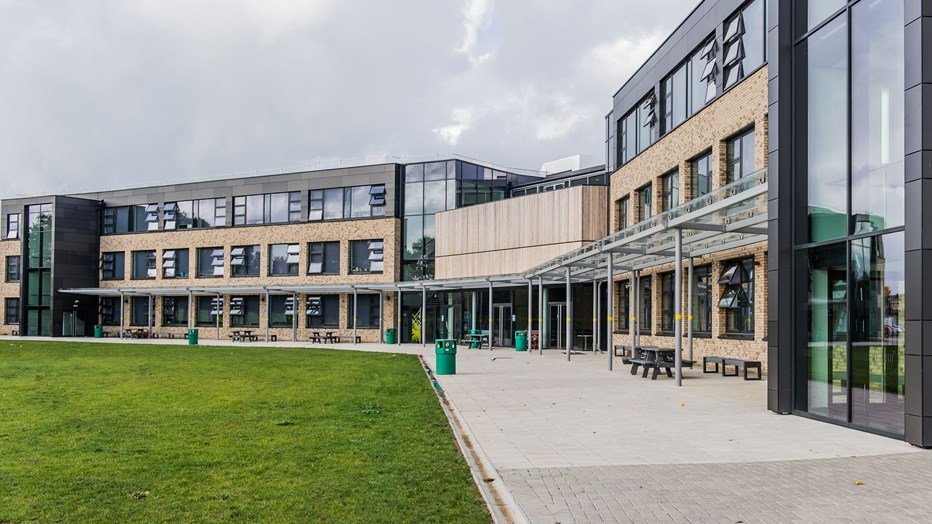
Our education work includes new classrooms and additions, career and technical shops, gymnasiums, libraries, science labs, administration buildings, maintenance facilities and bus garages. For the details of design and code, see education facility construction. For residence halls, student housing has its own code path and its own schedule demands.
Community colleges often have specialized programs: welding, diesel, nursing and agriculture. Northwest College in Powell, a public two-year residential college that also offers several four-year degrees through the University of Wyoming's extended campus, and Lander, home to the National Outdoor Leadership School and Wyoming Catholic College, show how varied the needs are. Shops need heavy slabs, exhaust, power and overhead doors. Labs need ventilation and casework. We coordinate with faculty so rooms match how programs actually teach.
What moves school construction cost
Education budgets come from bonds, state funds, grants and donors, and the amount is often fixed before design starts. That makes early cost control critical. We offer conceptual estimates at each design phase through construction management at risk, so you can adjust scope before the money is committed rather than after bids arrive.
Several things drive the number: site conditions, snow load on large roof spans, energy-efficient envelope requirements, security and technology infrastructure, and the cost of moving utilities. A gym with a long clear span carries a heavy roof load in a snowy town. We price that realistically, and we suggest alternatives such as a shorter span or a different structural system when the budget is tight.
Neighboring owners and shared projects
Education owners rarely build alone. Districts partner with towns on gyms and fields, colleges partner with health systems on nursing programs, and universities partner with developers on housing. Our work with public-sector owners and health systems gives us experience with the contracts and approvals those partnerships require.
Close-out matters as much as construction. We train custodial and maintenance staff, deliver manuals and warranties and stay available for the first winter. The first winter reveals problems with snow guards, drainage, entries and mechanical systems, and we would rather fix them under warranty with you than hear about them in the spring.
Plan your summer work now
Send us your capital plan, your bond schedule and the dates your buildings must be empty. We will return a program, a budget range and a summer schedule that holds up. District buildings sometimes include teacher or staff apartments, and our work with multifamily developers covers those. For the buildings themselves, see our school building experience.
Questions Owners Ask
Which delivery method is best for a school district?
It depends on your board, your funding and your project. Hard bid gives price competition when the design is complete. Construction management at risk lets us price during design and keep the work inside a budget. Design-build speeds things up when the program is clear. We can explain the tradeoffs and work under whichever method your board approves.
How do you finish before school starts?
We work backward from the first day of class. Long-lead items such as roofing, mechanical units and casework are ordered early. We maintain a weekly schedule review with your facilities staff, and we identify the point at which a delay would force a temporary fix. That point is reported before it arrives.
Can you work on several small campuses at once?
Yes. We bundle similar projects into a program, move crews along a route and buy materials together. This works best when your drawings use the same details across sites. We will propose the grouping that saves the most travel.
What code and design loads apply to a school?
Wyoming adopted the 2024 International Codes on June 28, 2024, but the local jurisdiction enforces them and sets its own design snow, wind and frost values. Evanston publishes a 40 psf minimum snow load and 54 inch footings, while Wright publishes 30 psf and 42 inches. We use the numbers for your town.